Overview: Rabbi Markus (Mordechai) Rottenberg (1872–1944) was an Orthodox rabbi who served as the Chief Rabbi of Antwerp and as the rabbinic leader of the Machsike Hadass community from the early twentieth century until his deportation during the Holocaust. He played a central role in the development of Orthodox Jewish communal life in Antwerp, particularly through his leadership of the Machsike Hadass community and his connection with the Oosten Shul (Oostenstraat Synagogue), which became one of the main Orthodox synagogues of Antwerp.
During the Holocaust, Rabbi Rottenberg was deported and murdered in Auschwitz in 1944. He was the father of Rabbi Chaim Yaakov Rottenberg, who later became Chief Rabbi of Antwerp and Paris, and Recha Sternbuch, a Jewish rescue activist during the Holocaust.
Early Life and Family
Markus Rottenberg was born in 1872 in Kraków, Galicia, then part of the Austro-Hungarian Empire.
He came from a rabbinic family and was educated in the traditional Jewish institutions of Galicia. He received rabbinic training and became part of the Orthodox rabbinic leadership of Eastern European Jewry.
He married Sarah Hendel Friedman, daughter of Rabbi David Friedman of Tzehlem (Deutschkreutz), a rabbi from the Hungarian Orthodox tradition.
The couple had several children, including:
- Rabbi Chaim Yaakov Rottenberg (1909–1990) – later Chief Rabbi of Antwerp and rabbi of the Rue Pavée Synagogue in Paris.
- Recha Sternbuch (1905–1971) – active in Jewish rescue efforts during the Holocaust through organizations including Vaad Hatzalah.
- Other children, several of whom were murdered during the Holocaust.
Rabbinic Career Before Antwerp
Before moving to Belgium, Rabbi Rottenberg served as a rabbi in Wadowice, a Jewish community near Kraków in Galicia.
At the beginning of the twentieth century, many Jewish communities in Eastern Europe experienced major social and demographic changes, including migration to Western Europe. Antwerp became one of the destinations for Jewish immigrants from Poland and Galicia, particularly those involved in the diamond industry.
Arrival in Antwerp
Rabbi Rottenberg arrived in Antwerp in 1911 with his family.
At the time, Antwerp's Jewish population was expanding rapidly. The Orthodox Jewish community was organized around Machsike Hadass, a religious association founded to maintain traditional Jewish religious standards.
In 1913, Rabbi Rottenberg was appointed as an assistant rabbi of Machsike Hadass under Rabbi Noach Zvi Ullmann, who was then the senior rabbi of the community.
Following Rabbi Ullmann's departure and death, Rabbi Rottenberg became the leading rabbinic authority of Machsike Hadass.
He officially served as Chief Rabbi of Antwerp from 1918.
The Oosten Shul and Machsike Hadass
Rabbi Rottenberg was closely connected with the establishment of the Oosten Shul (Oostenstraat Synagogue), the main synagogue of Machsike Hadass.
The synagogue was built between 1911 and 1917 and became the central religious institution of Orthodox Jewish life in Antwerp. During the construction period, the Machsike Hadass community was led by Rabbi Noach Zvi Ullmann and Rabbi Markus Rottenberg.
The Oosten Shul served as the main synagogue of Machsike Hadass, a center for prayer services and religious gatherings, and a location for communal events and Jewish education.
Before World War II, Rabbi Rottenberg lived in the synagogue complex, reflecting the traditional connection between a community rabbi and the central synagogue of his congregation.
Under his leadership, Machsike Hadass became one of the leading Orthodox Jewish communities in Belgium.
Leadership of Antwerp Orthodoxy
As Chief Rabbi of Machsike Hadass, Rabbi Rottenberg was responsible for religious matters within the Orthodox community.
His responsibilities included leading the rabbinical court, providing rulings on Jewish law, supervising religious institutions, and guiding the community in matters of Jewish practice.
His period of leadership coincided with the growth of Antwerp's Orthodox Jewish population between the First and Second World Wars. During this period, Antwerp developed a network of Jewish institutions, including synagogues, schools, charitable organizations, and kosher facilities.
First World War
During the First World War, Rabbi Rottenberg temporarily left Antwerp and stayed in Frankfurt, Germany, where members of his family remained during the war years.
After the war, he returned to Antwerp and resumed his rabbinic leadership.
In 1919, Belgian authorities investigated accusations that he had shown sympathy toward Germany during the First World War. The investigation concluded that there was no evidence supporting these accusations.
Nazi Occupation and the Antwerp Pogrom
After Germany invaded Belgium in 1940, Jewish communities throughout the country were subjected to increasing restrictions and persecution.
In April 1941, violent anti-Jewish riots took place in Antwerp. The Machsike Hadass community and the Oosten Shul were among the Jewish institutions attacked.
During the attack, the Oosten Shul was vandalized, Torah scrolls were desecrated, and religious objects and furniture were damaged and burned. Rabbi Rottenberg's apartment in the synagogue complex was destroyed.
The destruction of the Oosten Shul became one of the most significant acts of anti-Jewish violence against Antwerp's Jewish community before the mass deportations began.
After the attack, Rabbi Rottenberg and his family were forced to leave their residence and moved to another location in Antwerp.
Arrest and Deportation
On 8 January 1943, Rabbi Markus Rottenberg and his wife Sarah were arrested by the German occupation authorities.
They were transferred to the Dossin Barracks in Mechelen, the transit camp from which Belgian Jews were deported to Auschwitz.
Through foreign nationality documents obtained through Jewish rescue organizations, including documents identifying them as Paraguayan citizens, they were temporarily released. However, they were later arrested again.
They were transferred to the Vittel internment camp in France, where foreign Jews were held under the expectation that some might be exchanged for German citizens held abroad.
Death in Auschwitz
In 1944, Rabbi Markus Rottenberg and his wife were deported from France to Auschwitz-Birkenau. They were murdered there in 1944.
The Holocaust destroyed much of the prewar Orthodox Jewish leadership of Antwerp. Among Rabbi Rottenberg's immediate family, only a small number survived, including his son Rabbi Chaim Yaakov Rottenberg.
Family Legacy
Rabbi Markus Rottenberg's descendants continued his rabbinic and communal legacy.
Rabbi Chaim Yaakov Rottenberg (1909–1990)
His son, Rabbi Chaim Yaakov Rottenberg, survived the Holocaust and later became Chief Rabbi of Antwerp and rabbi of the Rue Pavée Synagogue in Paris. He continued the rabbinic tradition of the Rottenberg family after the destruction of European Jewish communities.
Recha Sternbuch (1905–1971)
His daughter Recha Sternbuch became involved in Holocaust rescue efforts. Together with her husband, Isaac Sternbuch, she helped rescue Jews during the Holocaust by organizing aid, obtaining documents, and assisting refugees.
Rabbi Mordechai Rottenberg
His grandson, Rabbi Mordechai Rottenberg, became the rabbi of the Rue Pavée Synagogue in Paris, continuing the family's rabbinic tradition.
Legacy in Antwerp
Rabbi Markus Rottenberg is considered one of the central figures in the history of Orthodox Judaism in Antwerp before the Holocaust. His leadership shaped the development of Machsike Hadass and the Oosten Shul, which became symbols of Antwerp's Orthodox Jewish community.
His life represents the history of Antwerp Jewry during a period of major transformation: the arrival of Eastern European Jewish immigrants, the establishment of Orthodox institutions, the destruction of the Holocaust, and the rebuilding of Jewish life after the war.
The Machsike Hadass community and the Oosten Shul continue to exist as important institutions of Antwerp Jewish life.
Profile Archive
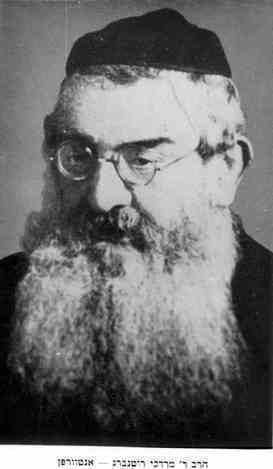
Portrait of Rav Rottenberg