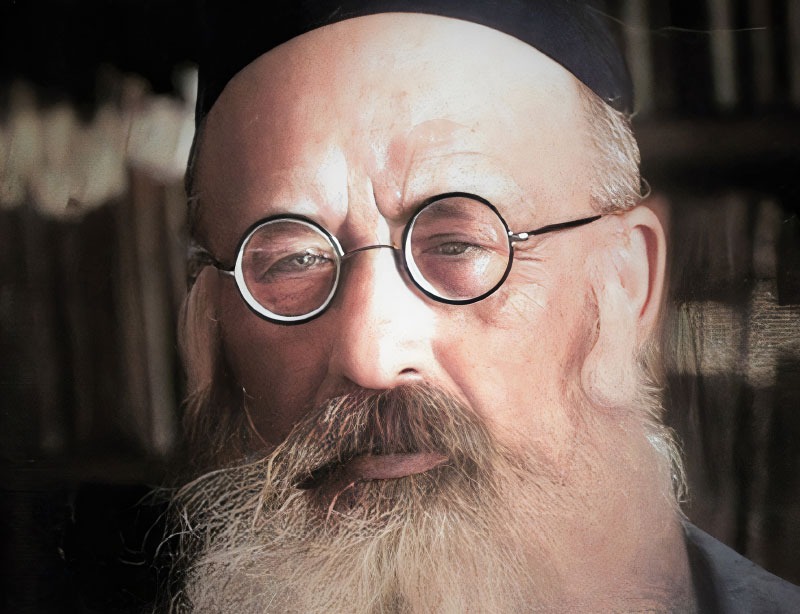
Overview: Rabbi Moshe Avigdor Amiel was one of the most influential rabbis to serve the Jewish community of Antwerp during the interwar period. A distinguished Talmudic scholar, gifted orator, pioneering Religious Zionist, and prolific author, he played a central role in strengthening Jewish religious life and education in the city. His sixteen years in Antwerp left a lasting impact through the establishment of educational institutions, communal organizations, and the promotion of Religious Zionist ideals. In 1936 he made aliyah to Mandatory Palestine, where he became Chief Rabbi of Tel Aviv.
Early Life
Moshe Avigdor Amiel was born on 12 Nisan 5642 (1882) in Pruzhany, near Grodno, then part of the Russian Empire (today Belarus). His father, Rabbi Yaakov Yosef Amiel, was a respected merchant and Torah scholar who introduced him to Jewish learning at an early age.
After studying in the local cheder and yeshiva, Amiel continued his education at the renowned Telz Yeshiva. He later studied in Vilna under Rabbi Chaim Ozer Grodzinsky and in Brisk under Rabbi Chaim Soloveitchik, two of the greatest rabbinic authorities of their generation. He also received rabbinic ordination from Rabbi Meir Simcha HaKohen of Dvinsk, author of Meshech Chochmah, and Rabbi Yosef Rosen, the celebrated Rogatchover Gaon. Ordained at only eighteen years of age, he quickly established a reputation as an exceptional scholar and preacher.
Rabbi in Eastern Europe
In 1905, Rabbi Amiel became Rabbi of Święciany (Sventzian), where he founded a large yeshiva and became known for his energetic leadership. Eight years later he accepted the rabbinate of Grajewo, on the border between the Russian and German Empires.
His sermons were widely admired for combining profound Torah scholarship with philosophical insight and passionate delivery. He possessed a rare ability to inspire audiences, earning recognition as one of the outstanding Jewish preachers of his generation.
During these years he also emerged as one of the earliest rabbinic supporters of the Mizrachi Movement, believing that Zionism and traditional Judaism should work together in rebuilding the Jewish homeland. Through his speeches and writings, he became an important voice for Religious Zionism in Eastern Europe.
Chief Rabbi of Antwerp
In 1920, Rabbi Amiel represented Polish Mizrachi at the World Mizrachi Convention in Amsterdam. His eloquence and leadership impressed Jewish communities in the Netherlands and Belgium, leading to his appointment as Chief Rabbi of Antwerp, one of Europe's largest and most prosperous Jewish communities.
Rabbi Amiel immediately devoted himself to strengthening Jewish communal life. He reorganized religious institutions, expanded communal services, encouraged charitable organizations, and worked closely with Jewish communities throughout Belgium.
One of his most enduring achievements was the founding of the Tachkemoni School in Antwerp in 1920. His vision was revolutionary for its time: providing boys and girls with a comprehensive Jewish education alongside a strong secular curriculum. The school became one of Europe's leading Jewish educational institutions and remains an important part of Antwerp's Jewish community today. Rabbi Amiel also promoted advanced Torah education through the establishment of additional yeshivot and religious educational frameworks.
His influence extended beyond Antwerp itself, helping smaller Belgian Jewish communities develop their own religious institutions, educational systems, and communal organizations. In Antwerp, his memory is also preserved in the Beth Hamedrash Rav Amiel (Mizrachi) synagogue.
Aliyah and Chief Rabbi of Tel Aviv
Despite his successful career in Belgium, Rabbi Amiel believed that Religious Zionism required personal commitment. In 1936, he made aliyah and accepted the position of Chief Rabbi of Tel Aviv, then the largest Jewish city in Mandatory Palestine.
His new role brought significant challenges. Tel Aviv's rapidly growing population included both religious and secular Jews, and Rabbi Amiel worked tirelessly to foster cooperation and mutual respect between the different segments of society.
Among his educational achievements was the establishment of Yeshivat HaYishuv HeChadash, a pioneering yeshiva high school that combined intensive Torah study with secular education. The institution later became a model for the Bnei Akiva yeshiva high schools established throughout Israel. Following his death, it was renamed Yeshivat HaRav Amiel in his honor.
Alongside his rabbinical responsibilities, he continued to serve as a leading figure within the Mizrachi movement, supported numerous Torah institutions, supervised religious services, presided over rabbinical courts, and represented religious interests before the authorities.
Scholar and Thinker
Rabbi Amiel was one of the leading rabbinic thinkers of Religious Zionism during the first half of the twentieth century. He authored numerous works on Halacha, Aggadah, Jewish philosophy (Machshava), ethics, and homiletics.
His writings consistently emphasized that the return of the Jewish people to their ancestral homeland should be accompanied by spiritual renewal. While recognizing that many Zionist pioneers were not fully observant, he believed they should be embraced rather than rejected, expressing confidence that national revival would ultimately strengthen Jewish faith and identity.
Death and Legacy
Rabbi Moshe Avigdor Amiel passed away on Erev Pesach, 5705 (1945) and was buried in the Nachalat Yitzhak Cemetery near Tel Aviv.
His legacy lives on through the institutions he founded, particularly the Tachkemoni School in Antwerp and Yeshivat HaRav Amiel in Tel Aviv. His combination of profound Torah scholarship, visionary educational leadership, eloquent preaching, and commitment to Religious Zionism made him one of the most influential Orthodox rabbis of his generation.
For Antwerp, Rabbi Amiel's sixteen-year rabbinate marked a transformative period in which modern Jewish education, communal organization, and Religious Zionist ideals became firmly rooted within one of Europe's most important Jewish communities.
References & External Links
- "Rabbi Moshe Avigdor Amiel: A Pioneer of Religious Zionism" — HaMizrachi Article (PDF).
- "Moshe Avigdor Amiel" on Wikipedia — Biographical Entry.
Profile Archive