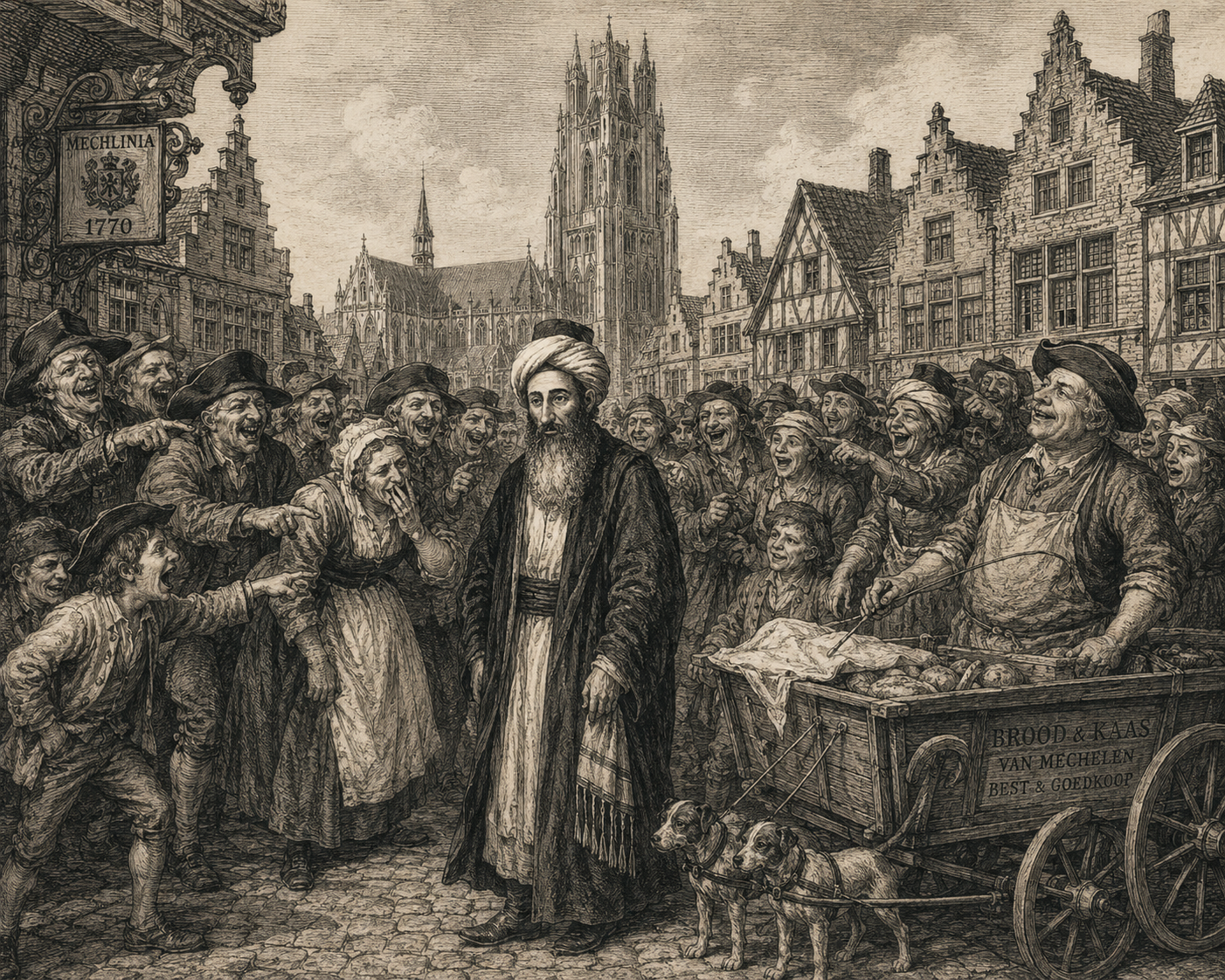
When Rabbi Chaim Yosef David Azulai—the legendary Sephardic sage, bibliophile, and emissary known across the Jewish world as the Chida—embarked on his sweeping European travels in the 1770s, his primary mission was to raise funds for the community of Hebron. Yet, his enduring legacy from these journeys is preserved in his remarkable travelogue, Ma'agal Tov (The Good Path). Far more than a mere ledger of donations, the diary serves as a vivid, unfiltered window into the social, cultural, and political landscapes of 18th-century Europe.
Among the most striking passages in Ma'agal Tov is the stark contrast the Chida experienced while navigating the brief geographic distance between two cities in the Austrian Netherlands (modern-day Belgium): Antwerp and Mechelen. Their contrasting receptions offer a powerful testament to the anxieties and isolation of a highly visible Jewish traveler moving through the pre-Emancipation Low Countries.
Antwerp: An Oasis of Quiet Hospitality
Arriving in the historic port city of Antwerp, the Chida entered an environment that, while no longer the bustling center of open Jewish life it had been during the Conversos era of the 16th century, still offered a peaceful respite.
In his diary, the Chida reflects on the relative safety and cosmopolitan nature of the city. Lacking a formal, established Jewish communal infrastructure, he was taken in by a local, pious Jewish hostess who provided him with kosher lodging and genuine respect. For a wandering scholar dedicated to rigorous study and strict halakhic observance, this quiet pocket of hospitality allowed him to rest, write, and observe the local culture without incident.
The Chida’s keen eye for detail is on full display during his stay in Antwerp. He marvels at the local infrastructure and the unique sights of the region. He meticulously records the distinct regional customs and even notes his fascination with the local dog-drawn carts—a ubiquitous transport method for small vendors in the Low Countries at the time. It was a moment of calm observation in an otherwise exhausting itinerary.
Mechelen: The Cruelty of the Crowd
The tranquility of Antwerp was shattered just a short distance down the road. Leaving the city, the Chida’s journey took him through transit points like the fortress of Lillo and into the deeply conservative, ecclesiastical stronghold of Mechelen.
As a prominent Sephardic rabbi, the Chida was a highly visible figure. He dressed in traditional oriental rabbinic garb, wore a flowing beard, and carried himself with an unmistakable air of dignified authority. In the cosmopolitan ports of Western Europe, this might have drawn curious glances; in the narrow, cobbled streets of Mechelen, beneath the towering shadow of St. Rumbold's Cathedral, it provoked outright hostility.
The Chida records a deeply distressing encounter where he was suddenly surrounded by a volatile, mocking crowd of local townspeople. Men, women, and children pointed fingers, jeered, and aggressively laughed at the foreign sage. For the locals, he was an object of alien fascination and deeply ingrained religious prejudice; for the Chida, it was a terrifying reminder of the fundamental vulnerability that accompanied the Jewish diaspora.
What makes the incident so poignant in Ma'agal Tov is the Chida’s internal response. Amid the mocking, aggressive crowd, he maintained his profound composure, relying on his deep faith and intellectual focus to carry him through the gauntlet of hostility.
A Microcosm of the Jewish Experience
The Chida’s journey from Antwerp to Mechelen stands as a brilliant microcosm of the late 18th-century Jewish experience in Europe. It illustrates the fragile, unpredictable tightrope that Jewish travelers had to walk—where true safety and hostility were often separated by nothing more than a few miles of cobblestone road.
Through Ma'agal Tov, the Chida did not just map the geographic routes of Europe; he mapped its soul, leaving behind an invaluable historical treasure that captures both the dignity of Jewish scholarship and the raw realities of the era.